
Managing customer reviews might seem like a customer service task, but for Joomla! site administrators in 2026, reviews have become a critical SEO ranking factor. Many admins focus on traditional optimization tactics like keywords and backlinks while overlooking the powerful impact of review signals on local search visibility. Reviews directly influence how Google evaluates your site’s prominence, trustworthiness, and relevance in local search results. This guide reveals how to harness review management and integration strategies to boost your Joomla! site’s SEO performance, covering everything from schema markup implementation to review velocity optimization and strategic response practices that drive measurable ranking improvements.
Table of Contents
- Understanding How Reviews Impact SEO For Joomla! Websites
- Enhancing Joomla! SEO With Review Schema Markup And Rich Snippets
- Managing Reviews To Build Trust And Improve SEO Outcomes
- Comparing Review Factors: Velocity, Rating, Volume, And Sentiment
- Boost Your Joomla! SEO With Review Integration Tools
- Frequently Asked Questions About Reviews And SEO For Joomla! Sites
Key takeaways
| Point | Details |
|---|---|
| Review signals rank among top 10 local SEO factors | Review count and rating affect local rankings through Google’s prominence metric |
| Schema markup increases click-through rates significantly | Proper structured data for reviews can boost CTR by 30-35% with rich snippets |
| Velocity matters more than volume | Generating 3-5 new reviews monthly impacts rankings more than total review count |
| Response strategy builds trust and ratings | Addressing negative reviews professionally improves overall ratings and customer confidence |
Understanding how reviews impact SEO for Joomla! websites
Google’s local search algorithm evaluates websites through multiple signals, and reviews play a surprisingly dominant role in determining rankings. When users search for local services or businesses, Google assesses prominence using review count, average rating, and review recency as key indicators of trustworthiness and popularity. These signals tell Google which sites deserve higher visibility based on real customer experiences.
Review signals are increasing in importance for local search ranking factors, now consistently appearing in the top 10 elements that determine where your Joomla! site appears in search results. This shift reflects Google’s focus on delivering results that real users have validated through their feedback. For Joomla! administrators, this means review management is no longer optional, it’s a core SEO responsibility.
The mechanics of how reviews influence rankings center on three primary metrics:
- Review count demonstrates social proof and engagement levels
- Average star rating signals quality and customer satisfaction
- Review recency shows ongoing business activity and relevance
- Response rate indicates active customer relationship management
Velocity, the rate at which you acquire new reviews, has emerged as particularly influential. Sites generating consistent new feedback signal active engagement and current relevance to Google’s algorithms. Research shows that businesses generating 3-5 new reviews monthly typically rank significantly higher than competitors with static review profiles, even when total review counts are similar.
“Prominence reflects how well known a business is. Some places are more prominent in the offline world, and search results try to reflect this in local ranking. For example, famous museums, landmark hotels, or well-known store brands are also likely to be prominent in local search results. Prominence is also based on information that Google has about a business, from across the web, like links, articles, and directories. Google review count and score factor into local search ranking. More reviews and positive ratings can improve your business’s local ranking.” – Google Business Profile Help
This official statement from Google confirms what SEO professionals have observed: reviews directly impact how your Joomla! site performs in local search contexts. Understanding this foundation helps you prioritize review strategies alongside traditional optimization efforts.
Enhancing Joomla! SEO with review schema markup and rich snippets
Implementing structured data for reviews transforms how your Joomla! site appears in search results, creating eye-catching rich snippets that display star ratings and review counts directly in search listings. These enhanced results stand out visually, drawing more clicks from users who see immediate social proof before visiting your site. Structured data markup for reviews enhances the appearance of search results, leading to higher click-through rates that compound your SEO benefits.

The impact of rich snippets on user behavior is substantial. When searchers see star ratings in results, they can quickly assess quality and relevance, making them more likely to click on listings with strong ratings. Studies indicate rich snippets can increase CTR by 30-35% compared to standard listings, translating directly into more organic traffic for your Joomla! site.
However, implementing review schema incorrectly creates serious risks. Incorrect implementation of review schema can lead to penalties or suppression of rich snippets, eliminating the visibility benefits you’re trying to achieve. Google’s guidelines are strict about authentic reviews and proper markup structure.
Follow these steps to implement review schema correctly on your Joomla! site:
- Choose the appropriate schema type (Product, LocalBusiness, or Organization) based on what you’re reviewing
- Include required properties like reviewRating, author, and datePublished for each review
- Ensure reviews represent genuine customer feedback, not self-promotional content
- Use aggregate rating markup when displaying overall ratings across multiple reviews
- Test your implementation with Google’s Rich Results Test tool before going live
- Monitor Search Console for structured data errors and warnings regularly
Pro Tip: Never use schema markup for reviews you write about your own products or services. Google explicitly prohibits self-reviews and can penalize sites that violate this guideline. Only mark up authentic third-party customer reviews to maintain compliance and preserve your rich snippet eligibility.
For Joomla! administrators without coding experience, specialized extensions can automate schema implementation while ensuring compliance with Google’s requirements. These tools handle the technical details of structured data insertion, reducing the risk of errors that could trigger penalties or suppress your rich snippets.
Managing reviews to build trust and improve SEO outcomes
Active review management goes beyond simply collecting feedback. How you respond to reviews, especially negative ones, significantly impacts both your SEO performance and customer perception. Many Joomla! site owners fear negative reviews, but research reveals a counterintuitive truth: negative reviews, if addressed promptly and professionally, can improve ratings and build trust with potential customers who see you as responsive and committed to customer satisfaction.
Your response strategy should focus on authenticity and timeliness. When customers see businesses engaging with feedback, both positive and negative, they perceive higher trustworthiness and are more likely to leave their own reviews. This creates a virtuous cycle where active management drives review velocity, which in turn boosts SEO performance.
Key elements of effective review management include:
- Responding to all reviews within 24-48 hours to show active engagement
- Personalizing responses rather than using generic templates
- Addressing specific concerns raised in negative reviews with solutions
- Thanking reviewers for positive feedback and highlighting what you’ll maintain
- Using responses as opportunities to naturally include relevant keywords
Review velocity, the consistent generation of new reviews, has become the most influential review-related ranking factor for local SEO. While total review count matters, Google’s algorithms increasingly prioritize sites that demonstrate ongoing customer engagement through fresh feedback. This shift reflects Google’s goal of surfacing currently active and relevant businesses rather than those relying on historical reputation alone.
Pro Tip: Create a systematic review request process that reaches customers at optimal moments. For service businesses, request reviews 2-3 days after service completion when satisfaction is high but the experience is still fresh. For product-based sites, time requests for 1-2 weeks after delivery when customers have had time to use and evaluate their purchase.
Generating authentic reviews requires making the process effortless for customers. Complicated review requests or multi-step processes dramatically reduce completion rates. Implement direct links to your review platforms, provide clear instructions, and consider automated follow-up sequences for customers who don’t respond to initial requests.
“87% of consumers read online reviews for local businesses in 2026, and 79% trust online reviews as much as personal recommendations. The quality and recency of reviews directly influence purchase decisions and search visibility.” – BrightLocal Consumer Review Survey
This data underscores why review management deserves dedicated attention in your SEO strategy. Reviews influence both how Google ranks your site and how users behave when they find you in search results, creating a dual impact on organic traffic and conversions.
Comparing review factors: velocity, rating, volume, and sentiment
Understanding which review elements most powerfully influence SEO helps you allocate resources effectively. Not all review metrics carry equal weight in Google’s ranking algorithms, and prioritizing the wrong factors can waste effort while delivering minimal results. Research comparing these elements reveals clear hierarchies in their SEO impact.
| Factor | SEO Impact | Optimal Strategy | Common Mistakes | | — | — | — | | Velocity (new reviews/month) | Highest impact on rankings | Generate 3-5 authentic reviews monthly | Buying fake reviews or review bursts | | Average Rating | Strong correlation with position | Maintain 4.2+ stars through quality service | Filtering negative reviews dishonestly | | Total Volume | Moderate impact after threshold | Build to 25+ reviews, then focus on velocity | Obsessing over competitor review counts | | Sentiment & Keywords | Influences CTR and relevance | Encourage detailed, specific feedback | Scripting reviews with exact keywords |
Review velocity and recency outweigh absolute review count and rating in determining local search rankings. A business with 30 reviews and 5 new reviews this month will typically outrank a competitor with 100 reviews but no recent feedback. This finding fundamentally changes how you should approach review strategy, shifting focus from accumulating total reviews to maintaining consistent new feedback.
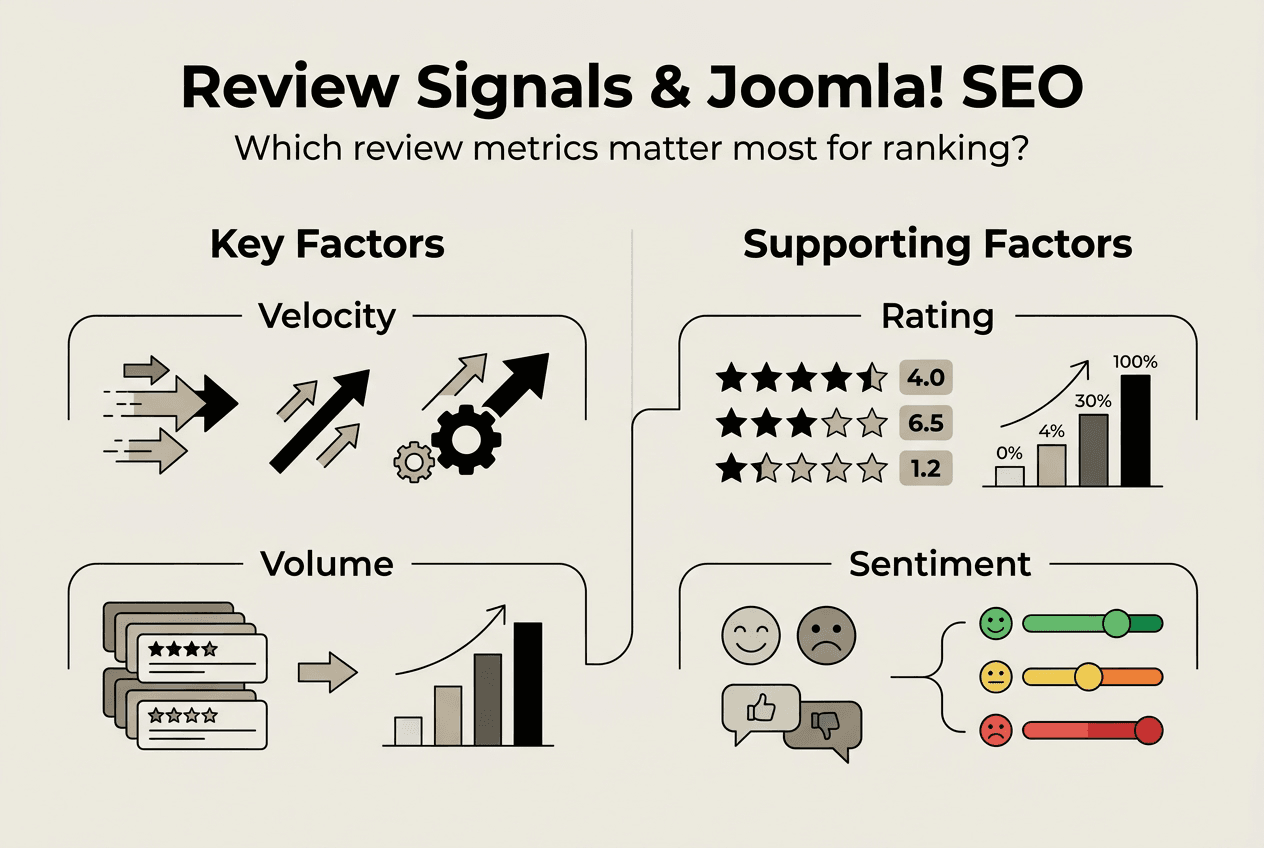
Average star rating remains important, with average star rating correlating strongly with search result position. However, the relationship isn’t linear. Moving from 3.5 to 4.2 stars produces significant ranking improvements, while the difference between 4.5 and 4.8 stars has minimal impact. This suggests a threshold effect where achieving “good enough” ratings matters more than pursuing perfection.
Key insights for prioritizing review factors:
- Velocity trumps volume once you exceed 15-20 reviews in your niche
- Rating improvements below 4.0 stars deliver outsized SEO benefits
- Detailed reviews with specific keywords enhance topical relevance signals
- Response rate to reviews amplifies the impact of all other factors
Sentiment analysis, while not a direct ranking factor, influences click-through behavior and conversion rates. Searchers who read reviews before clicking make more informed decisions, and sites with predominantly positive sentiment convert at higher rates. This creates an indirect SEO benefit as higher engagement metrics signal quality to Google’s algorithms.
Balancing these factors requires a strategic approach. Focus first on establishing consistent review velocity through systematic customer outreach. Once you’re generating 3-5 reviews monthly, optimize your service quality to maintain ratings above 4.2 stars. Address negative reviews promptly to prevent rating erosion, and encourage detailed feedback that naturally includes relevant keywords and location references.
Boost your Joomla! SEO with review integration tools
Managing reviews effectively across multiple platforms while maintaining proper schema markup and consistent velocity requires robust tools designed specifically for Joomla! environments. Specialized extensions automate the technical complexities of review integration, reducing implementation errors that could trigger penalties while streamlining the ongoing management process. Quality modules handle schema markup insertion automatically, ensuring compliance with Google’s evolving structured data requirements without requiring coding expertise.
The right review management tools transform a time-intensive manual process into an automated system that consistently drives SEO benefits. Look for solutions that aggregate reviews from multiple sources, implement schema markup correctly, and provide response management interfaces within your Joomla! dashboard. These capabilities let you maintain review velocity and engagement without switching between multiple platforms or risking schema implementation errors. Explore premium Joomla SEO modules designed to simplify review collection and schema integration while maximizing your site’s search visibility through proven optimization strategies.
Frequently asked questions about reviews and SEO for Joomla! sites
How quickly do new reviews impact my Joomla! site’s SEO rankings?
New reviews typically influence rankings within 1-3 weeks as Google recrawls your site and updates its assessment of your prominence signals. However, the full impact accumulates over time as consistent review velocity demonstrates ongoing relevance. You’ll see the strongest results after maintaining steady review generation for 2-3 months.
What’s the best way to measure review velocity for my Joomla! site?
Track the number of new reviews you receive each month across all platforms where your business is listed. Calculate your average monthly review count over the past 3-6 months to establish your baseline velocity. Compare this against competitors in your niche to identify opportunities for improvement. Tools that aggregate reviews from multiple sources simplify this tracking process.
Do reviews on third-party platforms affect my Joomla! site’s SEO?
Yes, reviews on Google Business Profile, Facebook, Yelp, and industry-specific platforms all contribute to your overall online reputation signals. Google considers your broader review profile across the web when assessing prominence. However, reviews directly on your Joomla! site, when properly marked up with schema, provide the most direct SEO benefit through rich snippets.
What are the risks of using fake or incentivized reviews for SEO?
Fake reviews violate Google’s guidelines and can result in severe penalties including complete removal from search results, suppression of all rich snippets, and manual actions that devastate organic visibility. Even incentivized reviews that offer discounts or rewards in exchange for feedback violate policies. The short-term ranking boost isn’t worth the catastrophic long-term consequences. Focus exclusively on authentic customer feedback.
How do I implement review schema on my Joomla! site without coding experience?
Use specialized Joomla! extensions designed for review management and schema markup implementation. These modules provide user-friendly interfaces for adding structured data to your review displays without manual coding. Always test your implementation with Google’s Rich Results Test tool and monitor Search Console for structured data errors. Quality extensions handle the technical details while ensuring compliance with Google’s requirements.