Images and other media are an essential part of social feeds, reviews and other third-party content displayed on modern websites. But there is a privacy detail that is easy to overlook: where those media files are actually loaded from.
Displaying an image from Instagram, LinkedIn, Google, Facebook or another external service may look like a simple visual element on your website. Technically, however, the visitor's browser may need to connect directly to a third-party server to retrieve that image.
This means that displaying third-party content can create network requests that happen outside your own website.
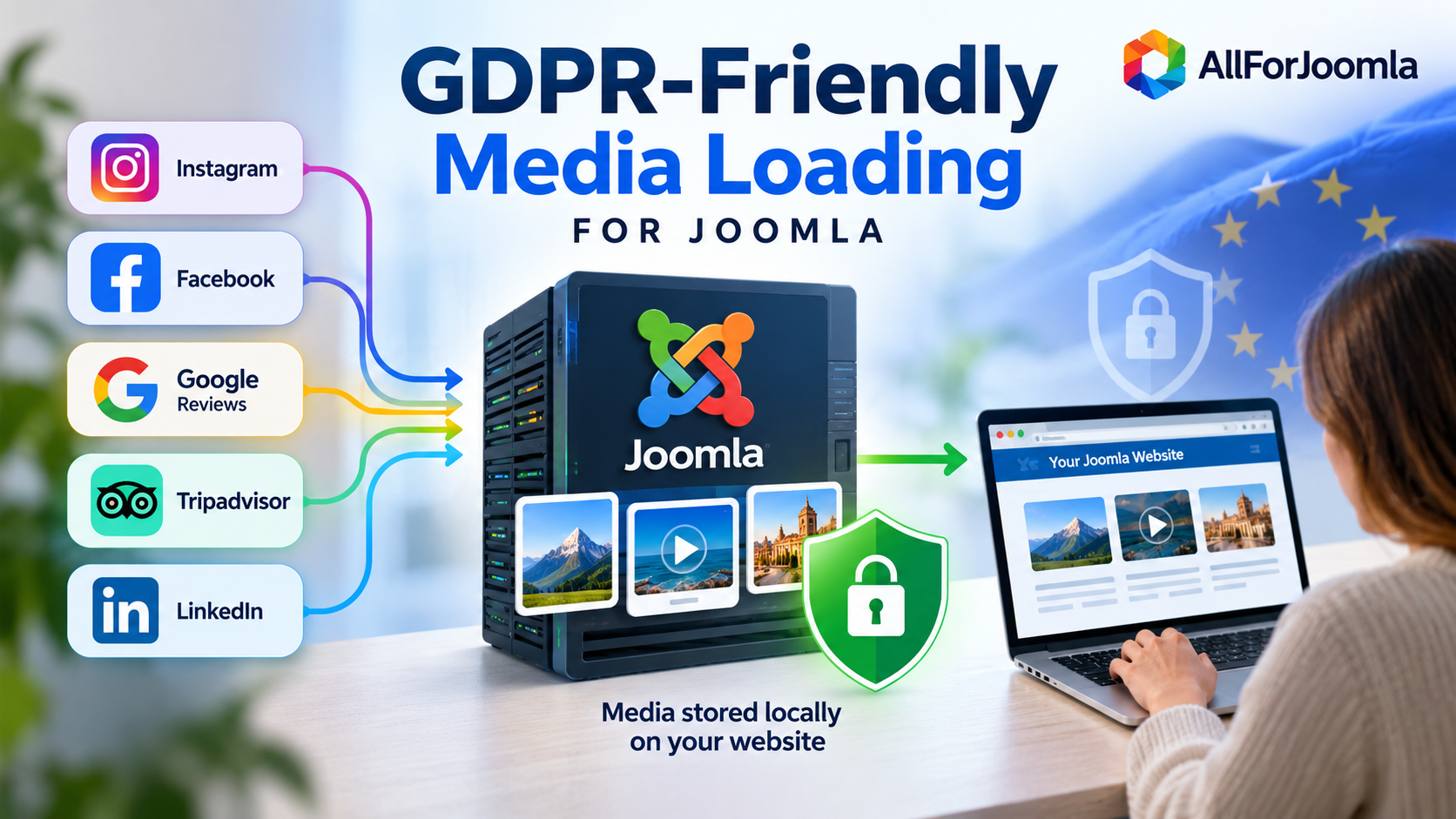
To give Joomla website owners greater control over these requests, AllForJoomla extensions support a technology we call GDPR-Friendly Media Loading.
It allows external media to be downloaded by the Joomla website and served locally to visitors, preventing their browsers from contacting the original media server just to display those files.
🌐 What Happens When a Website Loads External Media?
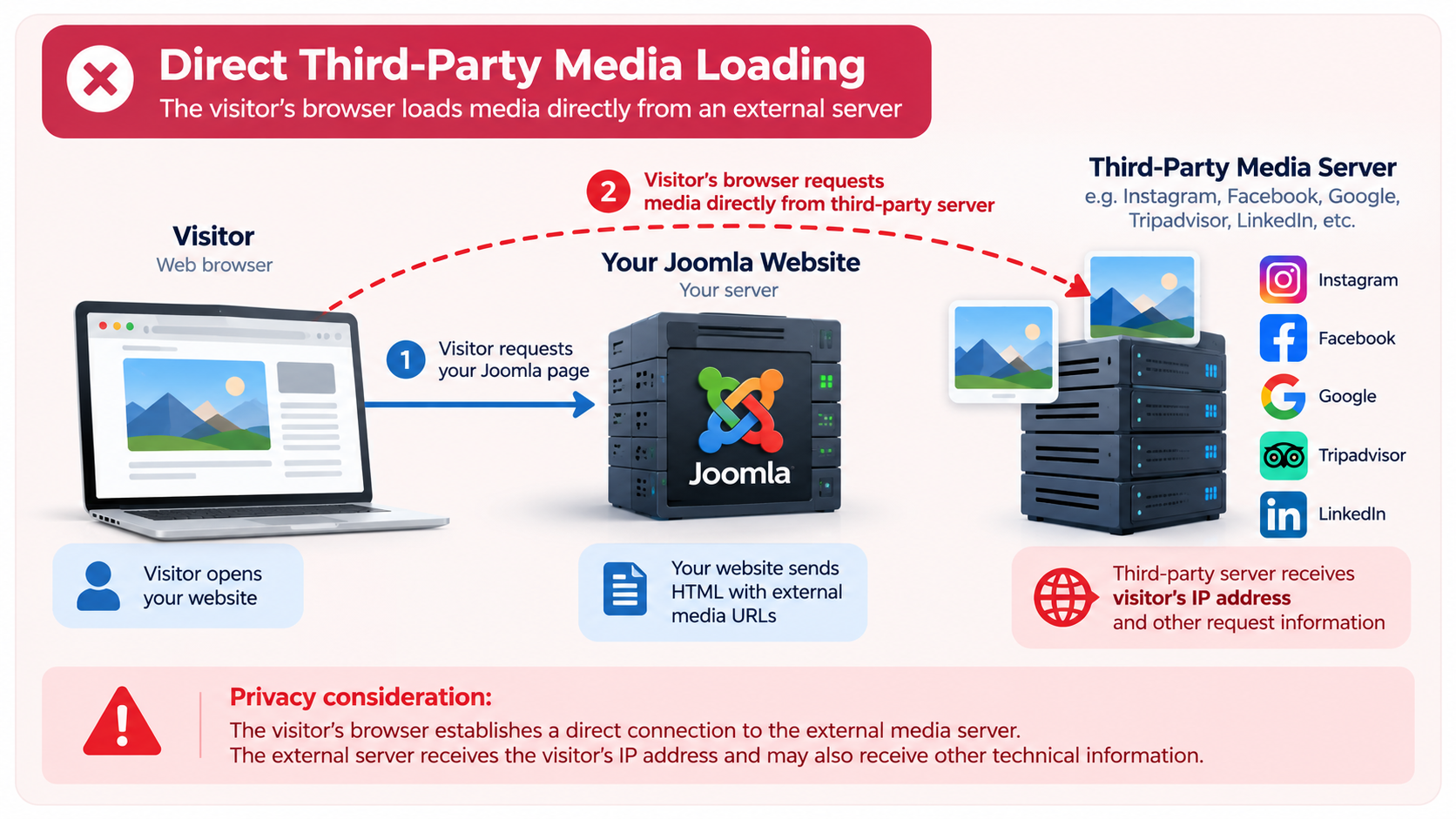
Consider a Joomla page displaying an image from an external service.
With traditional remote media loading, the HTML sent to the visitor may reference an image hosted on an external CDN or media server.
The process is essentially:
Visitor → Your Joomla Website
followed by:
Visitor → Third-Party Media Server
The second request happens because the visitor's browser needs to retrieve the external image.
As with normal web communication, the external server receives technical information required to handle that request. Most importantly, the server receives the IP address from which the request originates. Depending on the resource, browser and server configuration, other HTTP request information may also be transmitted.
This happens even though the visitor originally opened your website, not the website of the media provider.
🔐 Why IP Addresses Matter for Privacy
Cookies are often the first thing people think about when discussing online privacy, but cookies are not the only consideration.
Recital 30 of the EU General Data Protection Regulation (GDPR) specifically identifies Internet Protocol addresses among the online identifiers that may be associated with natural persons.
The Court of Justice of the European Union has also addressed IP addresses in its case law. In the Breyer judgment (Case C-582/14), the Court held that a dynamic IP address can constitute personal data in relation to a website operator where that operator has legal means enabling identification of the person using additional information held by the Internet service provider.
For website owners, this means privacy considerations should not be reduced simply to the question:
"Does this third-party server set cookies?"
Another useful question is:
"Does my visitor's browser need to contact this third party at all?"
That is the problem GDPR-Friendly Media Loading is designed to address for external media.
🛡️ How GDPR-Friendly Media Loading Works
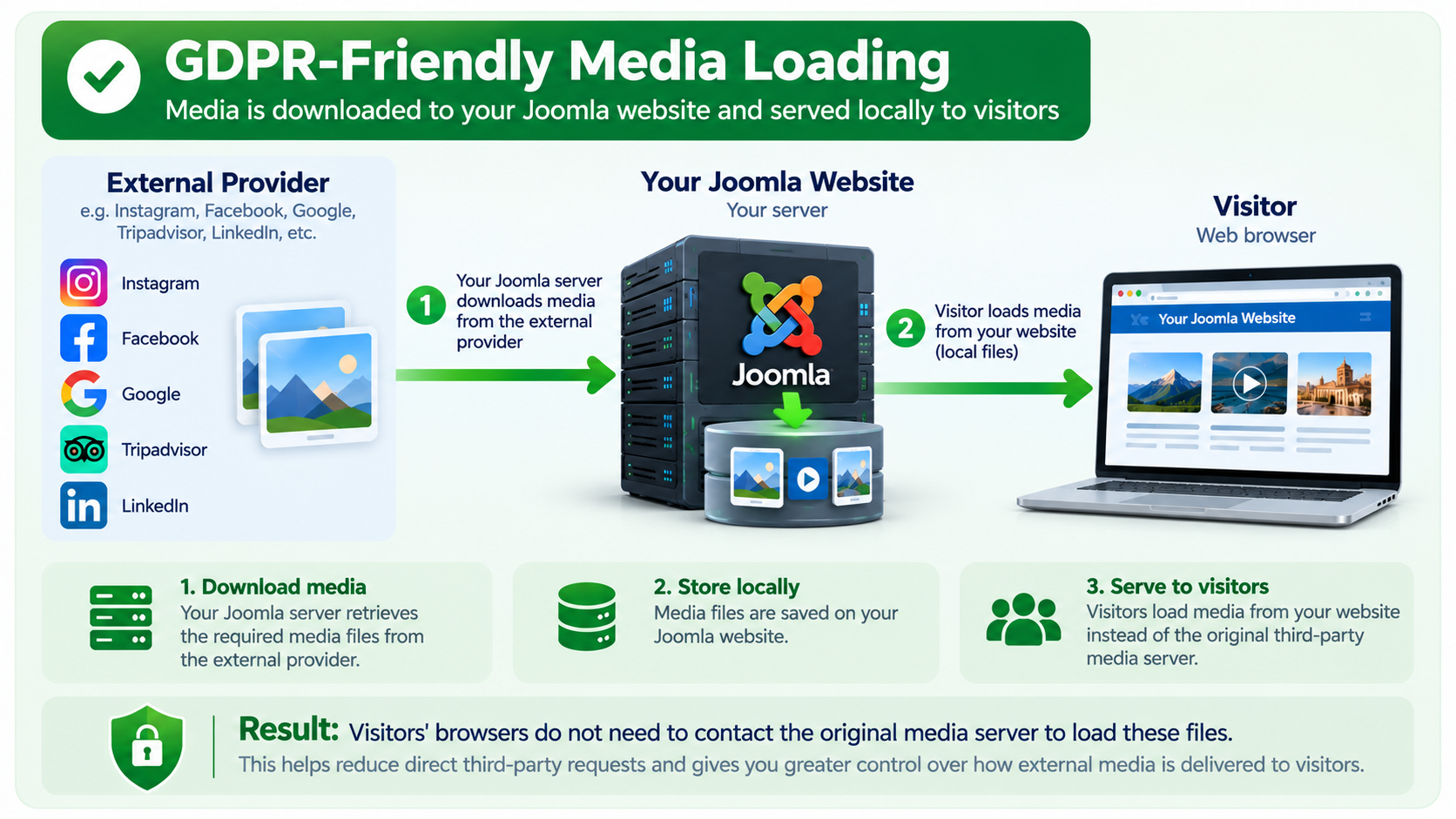
When local media loading is enabled in a supported AllForJoomla extension, the architecture changes.
Instead of giving the visitor's browser the original external media URL, the Joomla website retrieves the media file and stores it locally.
The process becomes:
External Provider → Joomla Server → Visitor
rather than:
External Provider → Visitor
In practical terms:
- The AllForJoomla extension receives the content and information about its media.
- Your Joomla server downloads the required external media file.
- The media file is stored locally on your website.
- The extension uses the local media URL when rendering the content.
- The visitor's browser loads the file from your website instead of the original third-party media server.
The important difference is step 5.
When the visitor opens the page, their browser does not need to contact the original media provider to retrieve that locally stored media file.
👤 What Changes for the Visitor?
Without local media loading, displaying third-party media can cause the visitor's browser to establish a connection directly with the external media server.
With GDPR-Friendly Media Loading enabled, that media request stays between the visitor and the Joomla website they intentionally opened.
The Joomla server has already retrieved and stored the required media.
This helps reduce unnecessary third-party connections generated simply by displaying externally sourced content. It also gives the website owner greater control over how third-party media is delivered to visitors.
🍪 This Is Not Just About Cookies
A common assumption is that an external resource is privacy-friendly as long as the provider does not set cookies.
That does not tell the whole story.
A browser cannot request an external image, video thumbnail or similar resource without communicating with the server hosting that resource. Normal Internet communication requires the destination server to receive the IP address necessary to return the requested data.
GDPR-Friendly Media Loading therefore approaches the problem at a more fundamental level:
if the visitor's browser does not need to contact the third-party media server, that direct request does not occur.
Instead of attempting to control what an external server does after receiving a media request, local media loading removes the need for that particular browser-to-third-party request.
⚙️ Local Media Loading vs. Direct Media Loading
Both approaches have legitimate uses, which is why supported AllForJoomla extensions can provide control over how media is delivered.
Direct Media Loading
The visitor's browser retrieves media from the original external server or CDN.
Advantages:
- Media does not consume storage space on your Joomla server.
- Content can be delivered directly through the provider's infrastructure.
Privacy consideration:
- The visitor's browser establishes a direct connection to the external media server.
GDPR-Friendly Local Media Loading
Your Joomla server retrieves and stores the external media, then serves it locally to visitors.
Advantages:
- No direct visitor connection to the original media server is required for the locally stored media.
- External media retrieval is handled server-side.
- Website owners have greater control over media delivery.
- It can be particularly useful for websites with stricter privacy requirements.
Trade-off:
- Media files consume storage space on your Joomla server.
The appropriate mode depends on the requirements of each website.
🇪🇺 Useful for Privacy-Conscious European Websites
Privacy requirements are particularly important for businesses, organizations and agencies operating websites for European audiences.
A Joomla developer building a website for a company, public organization, association or other privacy-conscious client may want to minimize connections to external services wherever practical.
GDPR-Friendly Media Loading provides a technical option for doing exactly that when displaying third-party media through supported AllForJoomla extensions.
Instead of removing useful social or review content entirely, the website can display that content while serving its media locally.
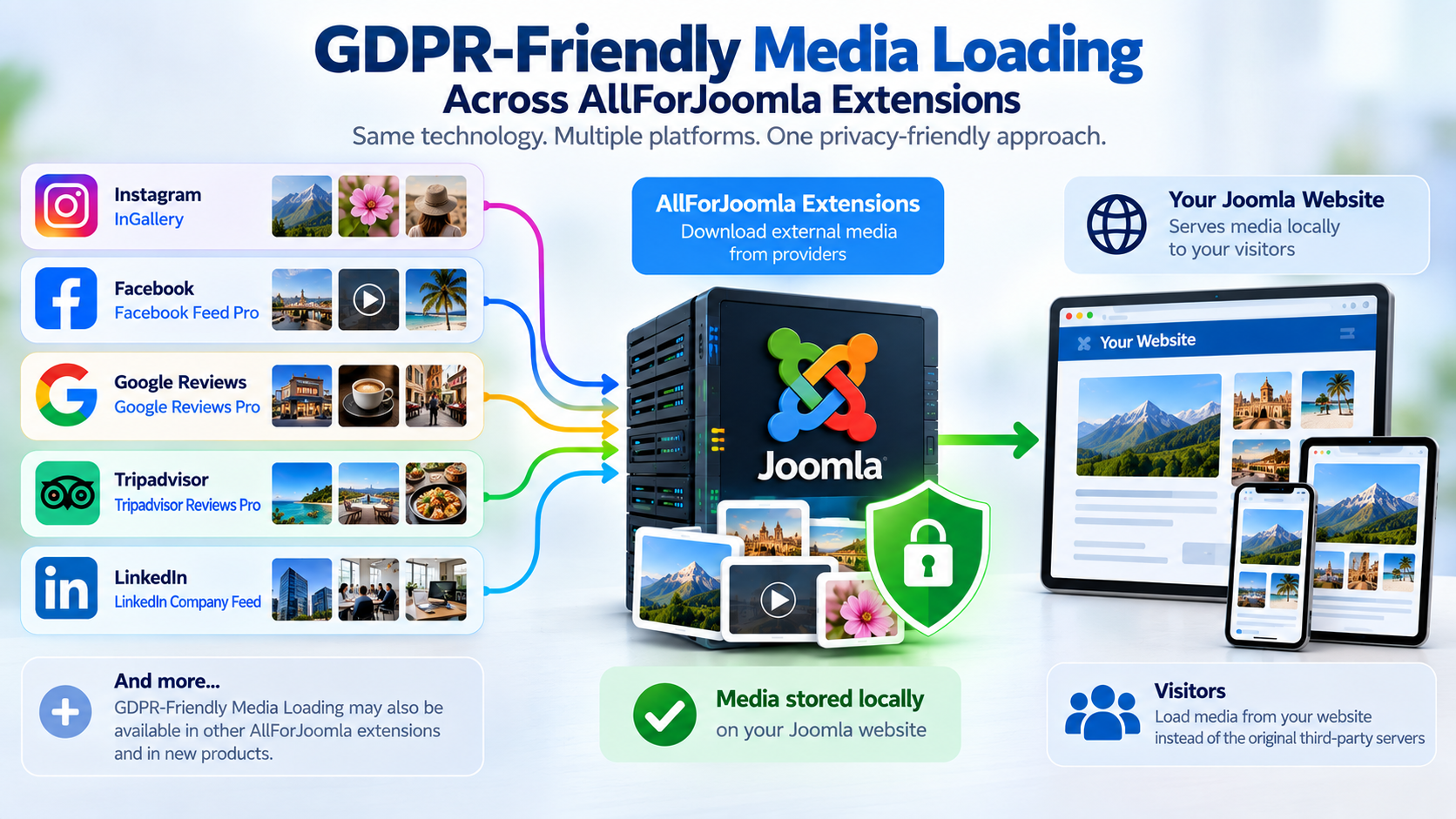
🧩 GDPR-Friendly Media Loading Across AllForJoomla Extensions
GDPR-Friendly Media Loading is not designed around one particular social network, review platform or Joomla extension.
The same local media loading approach is used across a number of AllForJoomla products that display externally hosted content.
Examples include:
- InGallery — locally downloads Instagram media instead of requiring visitors' browsers to load images directly from Instagram. ```
- Facebook Feed Pro — can store Facebook media on the Joomla website and serve it locally.
- Google Reviews Pro — provides a local media display mode for media associated with Google Business content and reviews.
- Tripadvisor Reviews Pro — can download external media and display it from the Joomla website's own server.
- LinkedIn Company Feed — can locally store media from LinkedIn company content and serve it directly from the Joomla website. ```
These are examples rather than a complete list. GDPR-Friendly Media Loading may also be available in other AllForJoomla extensions, and the technology can be incorporated into new products that display externally hosted media.
Regardless of the original content provider, the underlying principle remains the same:
External Provider → Joomla Server → Visitor
instead of:
External Provider → Visitor
This makes GDPR-Friendly Media Loading a reusable AllForJoomla technology rather than a platform-specific workaround.
⚠️ Does GDPR-Friendly Media Loading Make a Website GDPR Compliant?
Not by itself — and this distinction is important.
GDPR compliance depends on the complete website, the data it processes, the external services it uses, its configuration, the legal basis for processing, the information provided to visitors and other factors.
GDPR-Friendly Media Loading addresses a much narrower technical issue:
direct third-party requests made by visitors' browsers when loading externally hosted media.
Enabling local media loading can eliminate those direct media requests for locally stored files, but it should not be interpreted as a guarantee that an entire Joomla website is automatically GDPR compliant.
This is why we call the technology GDPR-Friendly Media Loading, rather than "automatic GDPR compliance."
💡 Privacy by Reducing Unnecessary Connections
Third-party content does not always have to mean third-party browser connections.
By moving external media retrieval from the visitor's browser to the Joomla server, AllForJoomla's GDPR-Friendly Media Loading provides website owners with a simple architectural choice:
Direct mode:
Visitor → Third-Party Media Server
Local mode:
External Provider → Joomla Server → Visitor
The content can still appear where it belongs. The difference is how it reaches the visitor.
For Joomla websites where privacy and control over external requests matter, local media loading provides a practical way to reduce unnecessary third-party connections without giving up useful external content.
❓ Frequently Asked Questions
What is GDPR-Friendly Media Loading?
GDPR-Friendly Media Loading is an AllForJoomla technology that downloads externally hosted media to the Joomla website and serves those files locally instead of requiring visitors' browsers to retrieve them directly from third-party media servers.
Why can loading an external image be a privacy consideration?
When a browser retrieves an image from an external server, it establishes a direct network connection with that server. The server receives technical information required for the connection, including the IP address from which the request originates.
Does local media loading prevent third-party media requests from visitors?
Yes. For media that has been downloaded and stored locally, the visitor's browser retrieves the file from the Joomla website rather than the original external media server.
Does GDPR-Friendly Media Loading require cookies to be blocked?
The technology addresses media delivery at the network-request level. Instead of relying on whether the external media server uses cookies, it prevents the visitor's browser from making the direct request to that server for locally stored media.
Does GDPR-Friendly Media Loading guarantee GDPR compliance?
No. GDPR compliance depends on the website as a whole and how personal data is processed. GDPR-Friendly Media Loading specifically helps reduce direct third-party connections associated with loading external media.
Does local media loading use server storage?
Yes. Because media files are downloaded and stored on the Joomla website, local media loading uses server storage. This is the main trade-off compared with loading media directly from an external CDN or media server.